

why high performers aren’t actually going offline
FC #39 Despite the Analog Trend, i'm Choosing to be Chronically Online

Despite the whole “analog life” trend for 2026, I’m choosing to be chronically online this year. I’m not giving myself the luxury of fully switching off yet. There’s still too much I want to build, and the internet is the only place where one person can turn effort into leverage at scale. Historically, scale required gatekeepers. You needed capital, connections, or credentials. Now you can open your phone, press record, and reach thousands.
in this issue:
why i’m choosing visibility over disappearing in my building season
how posting online shifted my trajectory more than traditional routes ever did
the difference between scrolling for entertainment and showing up with intent
why you don’t need a big audience, just the right eyes
what people misunderstand about social media being “toxic”
why going offline is often easier once foundations already exist
how the internet still functions as the most accessible leverage tool today

There’s this fatigue I am seeing online with creative people saying that they wish they didn’t have to post online as part of their strategy. I feel that.
Not many people know this, but I took a break from social media in my late teens where I had zero accounts, no Instagram, etc. I had tried to become a fashion influencer for a few years, and with little success I disappeared.
I was tired of feeling like I had to buy my way into a community. I realise now that that didn’t have to be the case, and I could have explored that niche in my own way. Nevertheless, having zero social media was a very peaceful and present time of my life. I liked being mysterious, private.
When I got it again, it was at university in first year, during freshers week, where to socialise and make friends meant asking people for ‘their snap’ or Snapchat (very nostalgic haha). I begrudgingly got it again, later followed by Instagram. It felt like in order to fit in, or to ‘keep up’, I had to do what everyone else was doing. I did also feel like if I didn’t post or keep up with others’ posts, it’s like I didn’t exist.
When I started posting on Instagram, it was very curated, aesthetically pleasing pictures. I was on holiday with my partner, forcing him to take these model-esque pictures of me at every occasion (looking back now, I realise this must have been annoying). I almost saw it as a hobby, a digital moodboard. A way of cultivating an image.
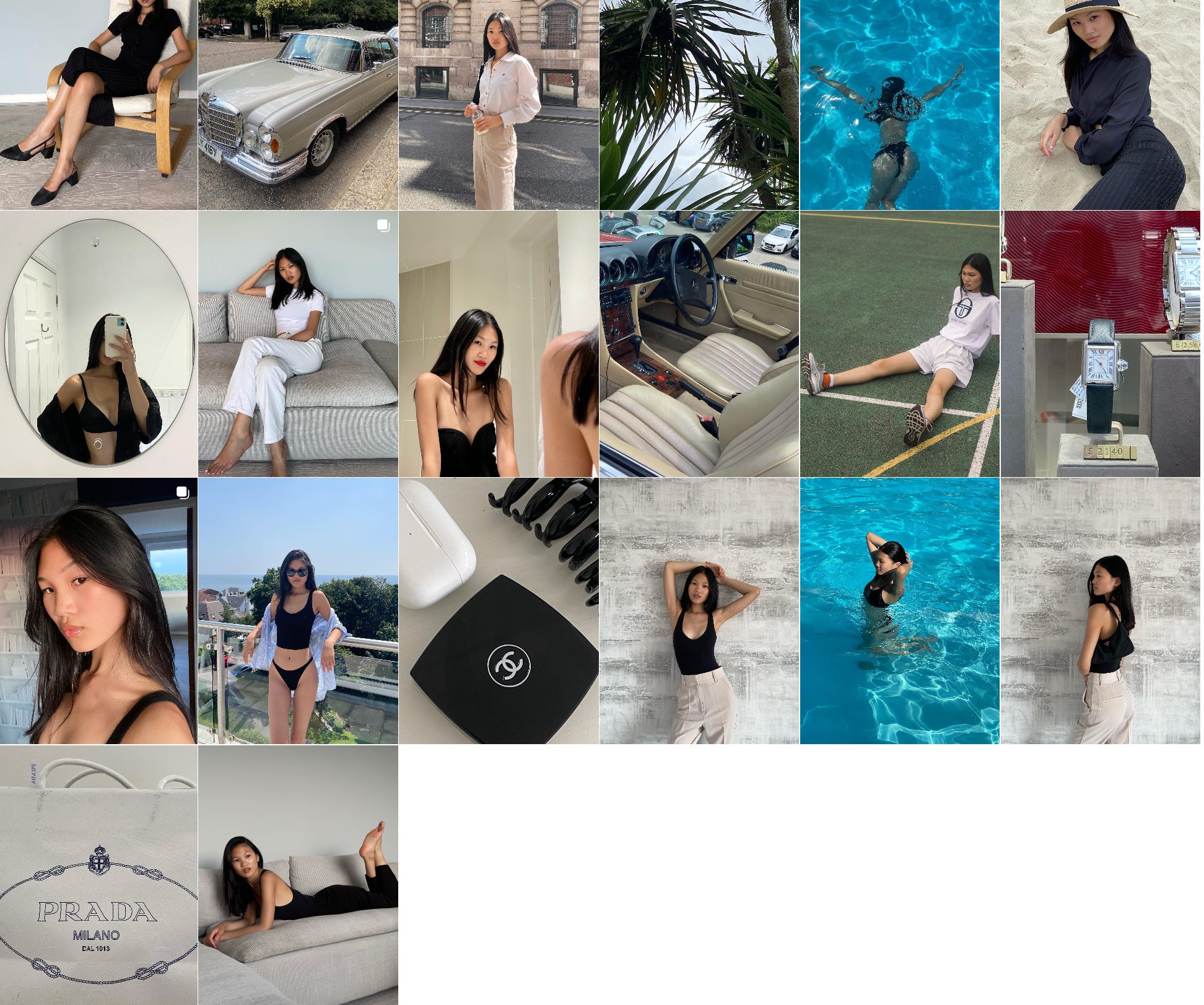
This unexpectedly got me signed with a modelling agency, who I am still with today. Other than my brief stint at trying to be a fashion influencer, it taught me the power of visibility. At the start I would get £120 a day for a shoot, which thinking back now was very low. But over time, I built my portfolio and landed bigger deals for £300–700. I remember the first time I got paid £2,000 for a shoot. That was the most money I’d seen in my life, and as a student, it made an impact.
However, I wasn’t very successful with modelling either. I’m short (in modelling standards), which limits me, plus there are people who want to do it more than me. I dreaded being asked to go to castings where I would wait two hours in a queue to be looked at like a piece of meat for 10 seconds and asked to leave and never contacted again. The concept of it is largely demoralising. I landed a few jobs here and there while studying and during my internship year, but overall, it was a small hobby.
The point is, I kept my socials because of that, and therefore I fell into the slippery slope of short-form content. At the time a friend said, “you need to get TikTok”. I didn’t at first because it seemed childish, I didn’t think there was any fashion content on there. When I finally got it, I was literally addicted to it, I would delete the app and redownload it. Spend hours unknowingly scrolling. I did get lots of tips and value from it, but I knew overall the habit of being on it wasn’t great.
Time passed and I started my internship in fashion. After getting promoted to the sales team and staying in a permanent place, I had an itch to try posting. We all know those familiar videos saying ‘just post the content’. They seem cringey, but eventually I saw so many of those types of videos that I thought, ‘yeah why not’. So it was one random midweek evening after my 9–5 that I decided to whip out my phone, tape it to my childhood bedroom window, and start filming.
From there I switched my addiction from scrolling to creating: seeing engagement, reading comments, seeing how I could improve my videos. I loved being able to talk about finance, even if I didn’t have a background in it. It was something I’d self-studied and learnt about, and also it wasn’t technical finance, it was day-to-day personal finance like budgeting and saving.

I can confidently say, the benefits outweigh the negatives when it comes to putting yourself out there. Yes, there’s the risk of looking silly, of your work seeing it, of judgement. I don’t usually talk so much about the benefits I experience or indulge in flex culture. I find this to be a bit distasteful, and if I do ever show numbers it’s only to add credibility so people will actually watch the video. But here, with my few set of close subscribers, I can openly say the benefits are more than you could imagine.
PR from dream brands, gifted hotel stays, beauty treatments (although I always say no to these usually), invited to do talks. The opportunities are immense. Yes, they aren’t guaranteed, and they’re a result of doing countless unpaid work too, posting mornings, evenings, and weekends around my 9–5, but the point is, they’re there. I don’t like to take the piss, but I know some influencers literally live for free, everything is gifted (this isn’t something I would do or advocate for, but it just shows, the option is there).
Now the point of this isn’t to become an influencer or think like one, but if I had just never posted, I wouldn’t have got that modelling opportunity, or the life-changing money that content creation can potentially give, nor would I have the option to forge my own career and be my own boss. I am seeing more and more ‘normal’ people just posting, not to get x amount of views, or try to monetise right away, but simply because they’re realising that if the right person can see it, that’s all they need.
My friend is an aspiring musician and wants to start running music events, from posting and getting a modest amount of views (respectfully, under 1,000, sometimes) she landed an event gig. It just shows that yes, while I am biased as I am speaking from the perspective of someone who now has the power that being an ‘influencer’ gives me, I started out with no intention of doing that. If I hadn’t liked the idea of being known, I would’ve done a similar thing to my friend, posted about my interests, achievements and spoke my desires into existence because you don’t know who’s listening.
You don’t need 100k people to watch a video if 100k of those people aren’t going to move any needles for you. You need one customer, one agent, one manager to see it and it can change your trajectory.
That’s why I won’t be neglecting the power of social media while this analog trend is happening. I’m in the building season of my life which means visibility is everything. Presence creates surface area for luck, opportunity, collaborations, and income streams. Opting out too early can sometimes mean opting out of momentum.
When people talk about how toxic social media is, it usually comes from the perspective of being a consumer. Purely being online and just being a consumer of content, I feel, is fairly toxic for your mental health, creativity, wealth prospects, because you’re constantly being marketed to. You don’t have much autonomy with algorithms, you’re purely just shown things, and you don’t have a lot of choice.
That difference matters. Consumption is passive, and increasingly with short form, your choice of what you consume is largely out of your hands. Creation on the other hand is active. One drains your bank account and attention, the other compounds. If your entire digital experience is scrolling, comparing, and absorbing, then yes, social media will feel damaging. But if your experience is building, publishing, testing, iterating, and learning, the exact same platforms function completely differently.
That doesn’t mean offline living is bad. It just means timing matters. There are seasons where you can log off, and seasons where showing up is part of the work. Not everyone is in the same season, and pretending otherwise can create unrealistic expectations for people who are still trying to establish themselves.
The real power move is choosing a side: log off completely, or build something.
That’s it for this week,

people are still online, they are just hiding it better!
A great read, Mia. Thank you for sharing.